

Getting access and turning it on
- Available on Scale, Advanced, or Enterprise. Ascend has been on by default since August 5 for organizations that didn’t opt out.
- Turning the agents on or off is an admin, org-level control at Settings → Automations & AI → Affinity AI (the Ascend card). Each user then turns Monitoring on or off for Meeting Prep and Data Update on the Ascend → Agents tab. It’s off until you turn it on.
- Affinity Notetaker — the primary source for post-meeting updates — is available on Scale, Advanced, or Enterprise.
The Meeting Prep agent — a pre-meeting brief
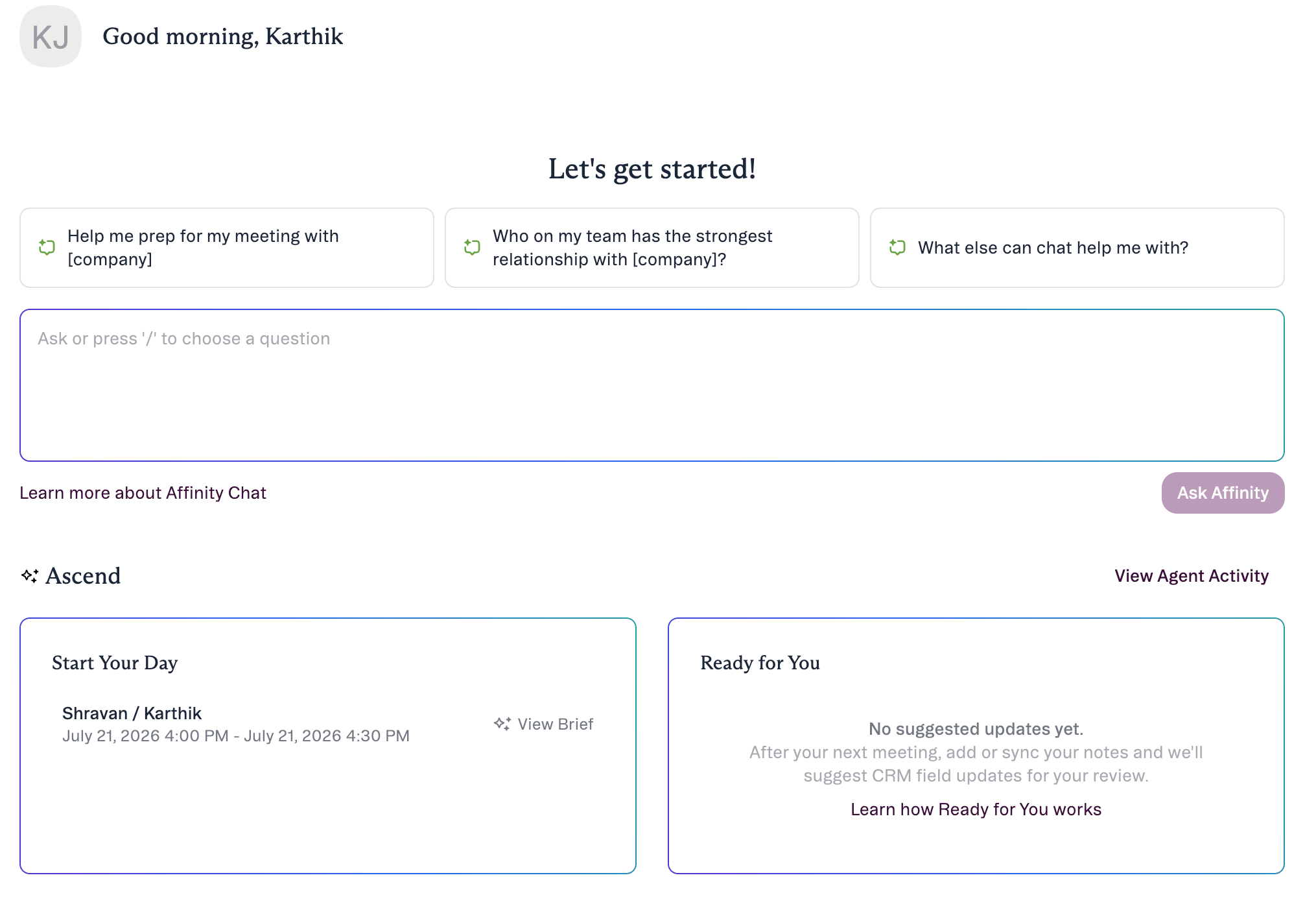
- The Meeting Prep agent scans your calendar and prepares a brief for your external meetings.
- Each brief pulls from your Affinity data: relationship history, the last interaction and how recent it was, who on your team is engaged, deal and pipeline context, and recent news on the company.
- What the [N1] and [A1] labels mean. Facts taken from your notes or from news carry a clickable label right after them. N labels ([N1], [N2]…) open the Affinity note the fact came from; A labels ([A1], [A2]…) open the news article. They’re numbered in the order they first appear in the brief. Everything else (company fields, activity, connections and meetings) comes straight from your Affinity data and has no label. Names of people, companies and opportunities link to their profiles instead.
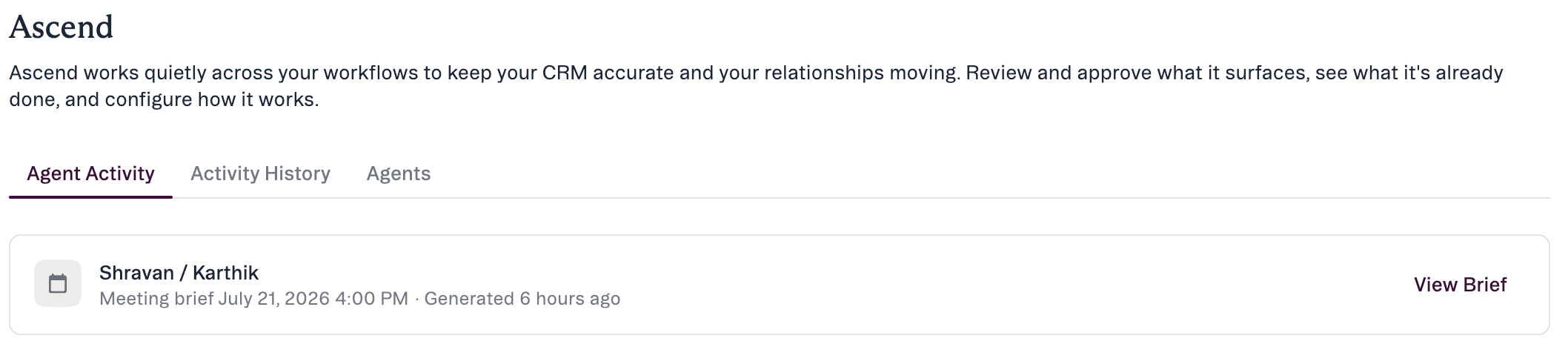
- When the Meeting Prep agent is monitoring your meetings, briefs are generated overnight and ready each morning by 7:00 AM in your local time zone. You can also generate a brief on demand for any external meeting, at any time. A brief surfaces in-app on the Affinity home page — in the “Start your day” / “Ready for you” modules — and in the Ascend Agent Activity feed. It appears in Affinity on the web (not email, Slack, or mobile). Open it with View Brief.
- Opening a brief brings up the Meeting Brief modal, which summarizes the person and relationship context. Add as note turns the brief into a note. It appears in Agent Activity as View Note; use this if you don’t have Affinity Notetaker, which otherwise creates that note automatically after the meeting. Depending on where you opened the brief from, you may also see Archive, which keeps the brief in Agent Activity until you archive it, then moves it to Activity History.
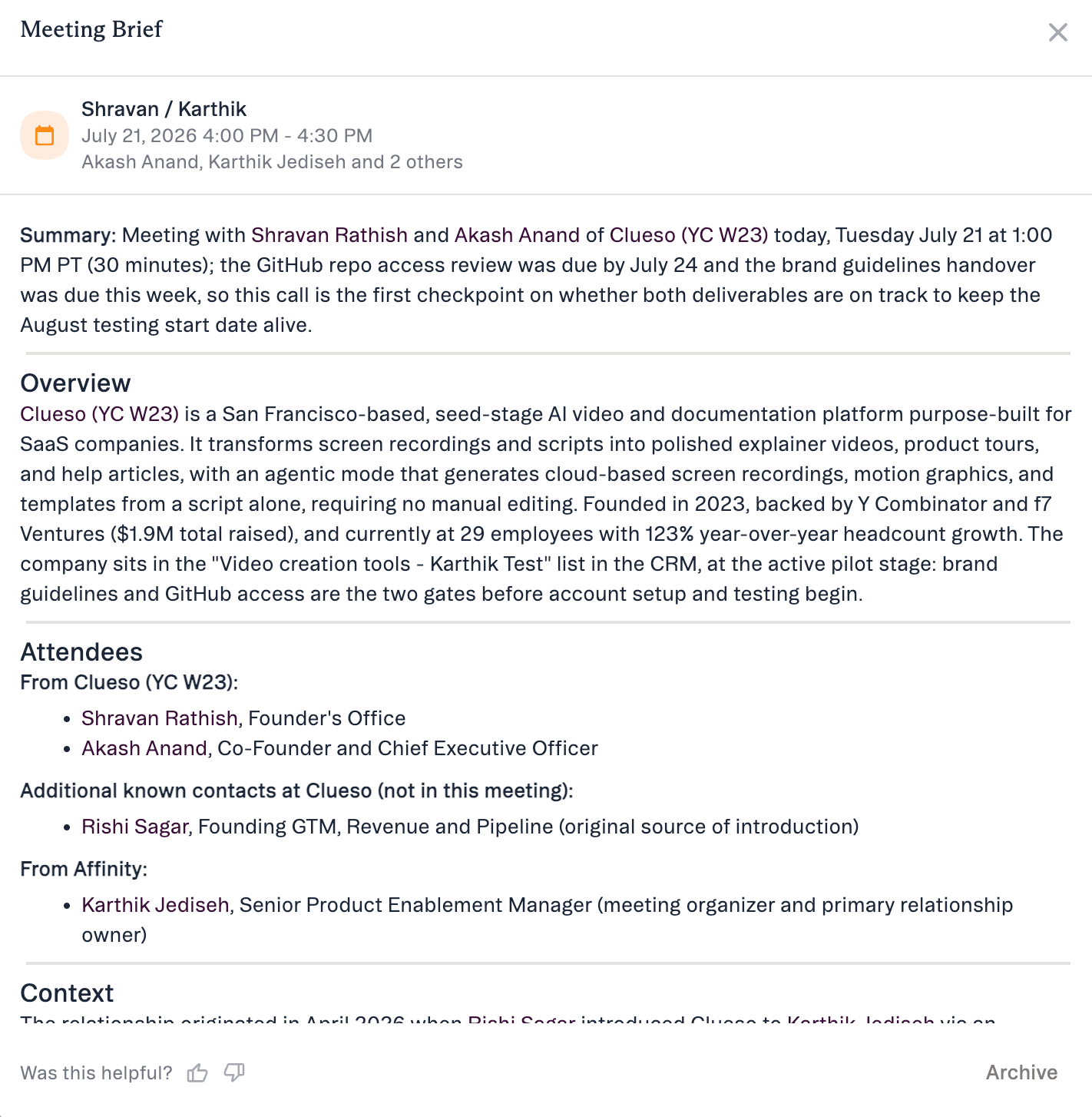
- The brief is prepared for you in advance, so you don’t have to research or ask.
Generate a brief on demand
You don’t have to wait for the overnight run. Every external meeting offers a brief from two places:- Meetings in the left nav — move to the meeting’s date and open the meeting.
- Start Your Day on your Affinity home page — the module lists your external meetings for a day, with a date toolbar to move between days.
- Click Generate Brief. The button switches to a loading state while the agent works.
- When the brief is ready, a notification appears in the top right — “Your meeting brief is ready” — with a View meeting brief link that opens the Meeting Brief modal.
- After that, open it any time with View Brief.
The ready notification only appears while you have the page open. If you navigate away or refresh
while a brief is generating, you won’t see it — the brief still generates, and you can open it with
View Brief when you come back.
Monitoring controls the automatic overnight run — not whether you can get a brief at all.
With Monitoring off, the Meeting Prep agent won’t prepare briefs for you overnight, but you can
still open any external meeting and click Generate Brief. That’s a good way to try the agent
before you turn it on.
What “Monitoring” means — and why a brief calls it something else. Monitoring is the general
term for letting an agent work on its own. What it actually does depends on the agent:
- Meeting Prep — automatically generates your meeting briefs.
- Data Update — generates suggested field updates whenever a new meeting note is created.
The Data Update agent — suggested field updates
The Data Update agent keeps your CRM current. It works from your meeting notes.- Once a meeting note is attached to an external meeting (Affinity Notetaker does this automatically; notes from Granola and most other notetakers attach to the person or company instead and won’t trigger it — see Does it need a notetaker? below), the agent reads the note and proposes CRM updates — usually in under a minute.
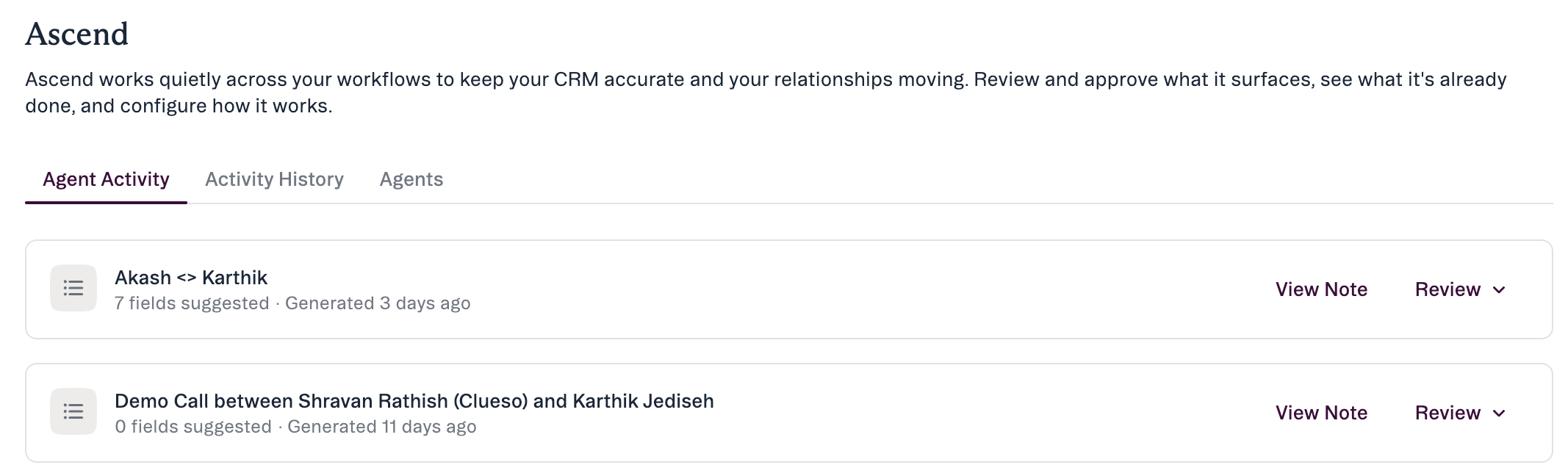
- In the Agent Activity item, expand Review. Each row shows the field, its scope (“All Lists” or a specific list), the Current Value (with its last-updated date), and the Suggested Value. The source is the linked View Note.
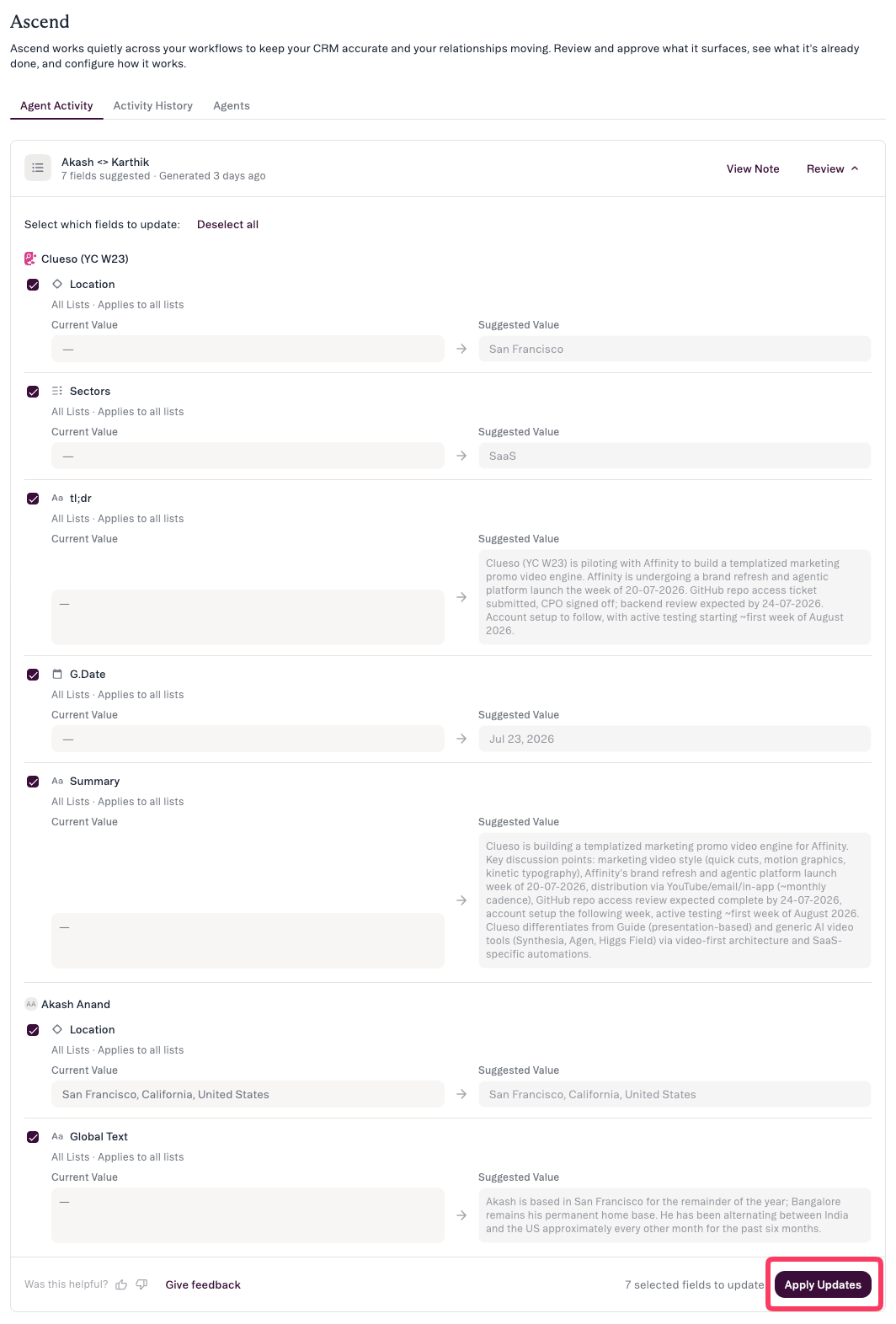
- Select which fields to update via checkboxes (or Select all), then click Apply Updates. Anything left unchecked is declined when you apply.
- It can suggest updates to any editable field — global or list-specific, except enriched fields — including dropdowns and Ranked Dropdown fields (Status, Stage, Priority); for multi-value fields it appends rather than overwriting. (This is a step up from the Labs version of Suggested Field Updates, which only covered a subset of fields.)
- Nothing is written to the CRM until you click Apply Updates. To change a suggested value before applying it, click Edit next to it (Reset undoes your change).
How the suggestions are made
When a meeting note is created, the Data Update agent picks it up automatically (new notes on external meetings). It works out which companies, people, and opportunities the note is about — from the note’s associations, or the meeting’s external attendees as a fallback — and which lists they’re on. If your team has added field descriptions in New Lists, the agent reads them too, so suggestions follow your units and formats (see Give Ascend agents your firm’s context). A single meeting can produce suggestions for several records at once. It works from the records linked to the meeting — not other companies merely mentioned in the note. It then looks only at the fields you can already edit (excluding enriched fields), reads the note against them, and proposes values it can support. Dropdown suggestions must match your real existing options; sensitive fields like job title are only suggested when explicitly stated; and it skips anything ambiguous, unresolvable, or already correct. Nothing is written automatically.Where they live
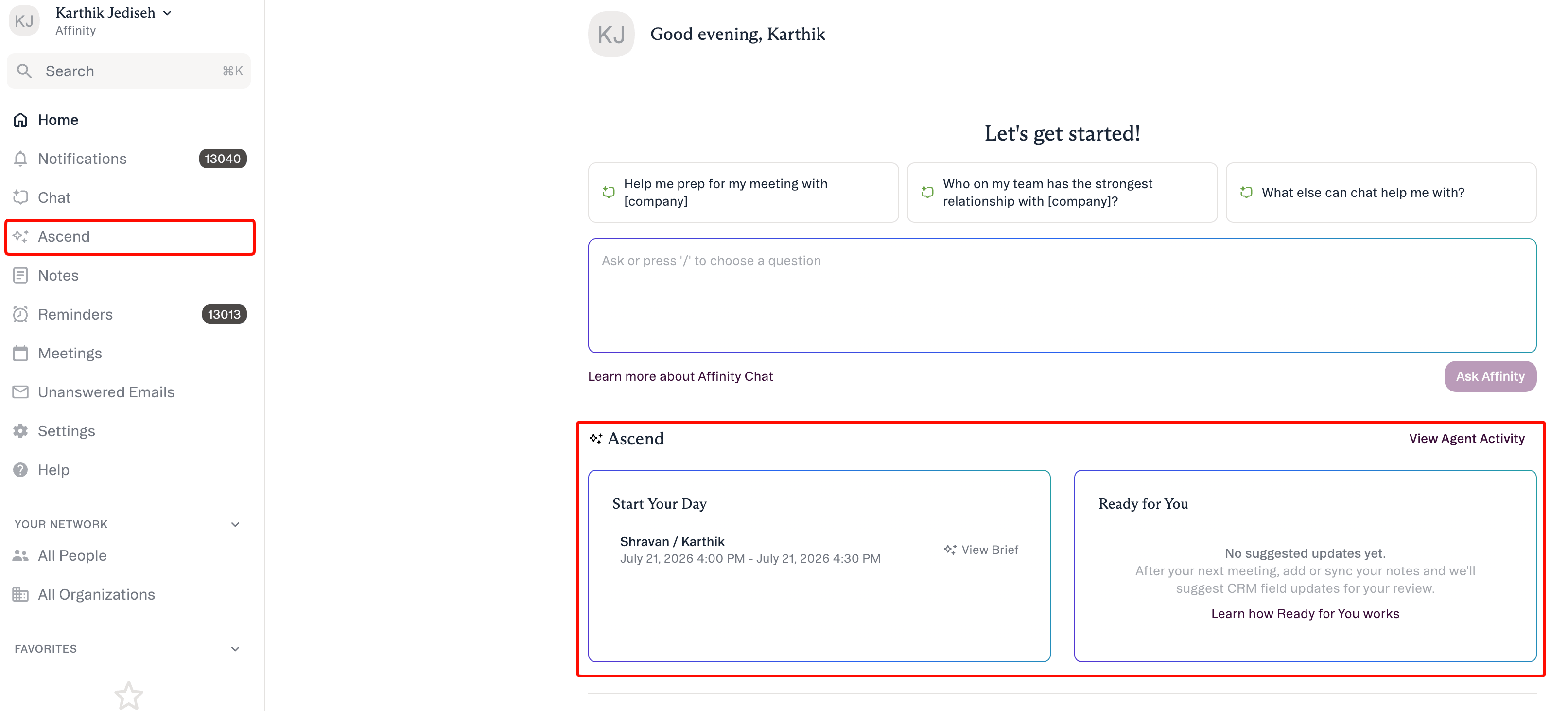
- Find both agents under Ascend in the left nav and on the home page. Agent names appear on the Agents tab.
- Agent Activity — the queue of briefs and suggestions waiting for review. Activity History — what the agents have already done (applied vs declined, with Previous → Suggested). Agents — turn each agent on or off (each is a background Monitoring agent).
- Note: Notetaker feeds these agents but isn’t part of Ascend.
How to stay in control
- Review before it’s real. Updates wait in Agent Activity until you act — see Review & approve an agent’s suggestions.
- It shows its work. Every suggestion names the field, its scope, and the Current → Suggested value, and links to the source via View Note.
- Quality-filtered. Low-quality, ambiguous, or already-correct suggestions are filtered out before they reach you.
- It won’t overwrite newer data. If a field’s value has changed since the suggestion was generated, that suggestion is rejected on apply.
- It won’t fire your automations. Applying a Suggested Field Update does not trigger Status/Stage automations.
- It respects your permissions. Each agent only sees and changes what your account already can.
Common questions
- Does it need a notetaker? It works from your meeting note, so a note has to exist. Affinity Notetaker takes the note and attaches it to the meeting automatically. Granola and other AI notetakers also work, but historically they attach notes to the person/company record only, not the meeting — so those won’t trigger field updates. See Getting your meeting notes into Affinity.
- Will it change my pipeline automatically? No. Updates queue for your approval; nothing applies on its own.
- Where do the pre-meeting briefs show up? In-app on the “Start your day” / “Ready for you” homepage modules and the Ascend Agent Activity feed. Affinity web only. Open one with View Brief.
- A meeting was added at the last minute — can I still get a brief? Yes. Open the meeting from the Meetings panel or Start Your Day and click Generate Brief. The same works days ahead of a meeting, and for meetings that have already happened.
- What if it suggests the wrong value? If it’s close, click Edit and correct it before applying. If it shouldn’t be applied at all, leave its checkbox unchecked so it’s declined.
- How is this different from the Labs “Suggested Field Updates”? The agent version covers every editable field except enriched fields, including list-specific fields and dropdowns; the Labs version only covered a subset.
- Which meetings does it cover? External meetings (internal meetings are excluded).
Affinity AI can make mistakes. Review each suggestion before approving it.