

Overview
Affinity Data Share gives your team read-only access to your Affinity data inside your own Databricks workspace, using Delta Sharing (Unity Catalog). Instead of building an export or a pipeline, Affinity shares your CRM data directly into Databricks — where you can query it and connect it to your BI tools and dashboards. Direction of sync: Affinity → your Databricks, read-only. The share never writes back to Affinity.Enterprise add-on (Beta) — contact us to enable. The Databricks integration is available on Advanced and Enterprise plans as a paid add-on that Affinity turns on for your account — it isn’t self-serve, and it’s currently in Beta. Contact your Affinity account manager (or support@affinity.co) for pricing and to have it enabled.
Prerequisites
- Data Share enabled for your Affinity organization (see above).
- Admin access in Affinity — you set up the connection in Settings.
- A Databricks workspace enabled for Unity Catalog.
- Your Databricks sharing identifier, and the rights to mount a share — metastore admin, or the
CREATE CATALOGandUSE PROVIDERprivileges.
Step 1: Find your Databricks sharing identifier
- In Databricks, open the Catalog icon in the left sidebar.
- Click the gear icon and open your metastore settings.
- Copy the sharing identifier — it’s in the format
<cloud>:<region>:<uuid>(for example,aws:us-west-2:xxxxxxxx-xxxx-xxxx-xxxx-xxxxxxxxxxxx).
Step 2: Connect Databricks in Affinity
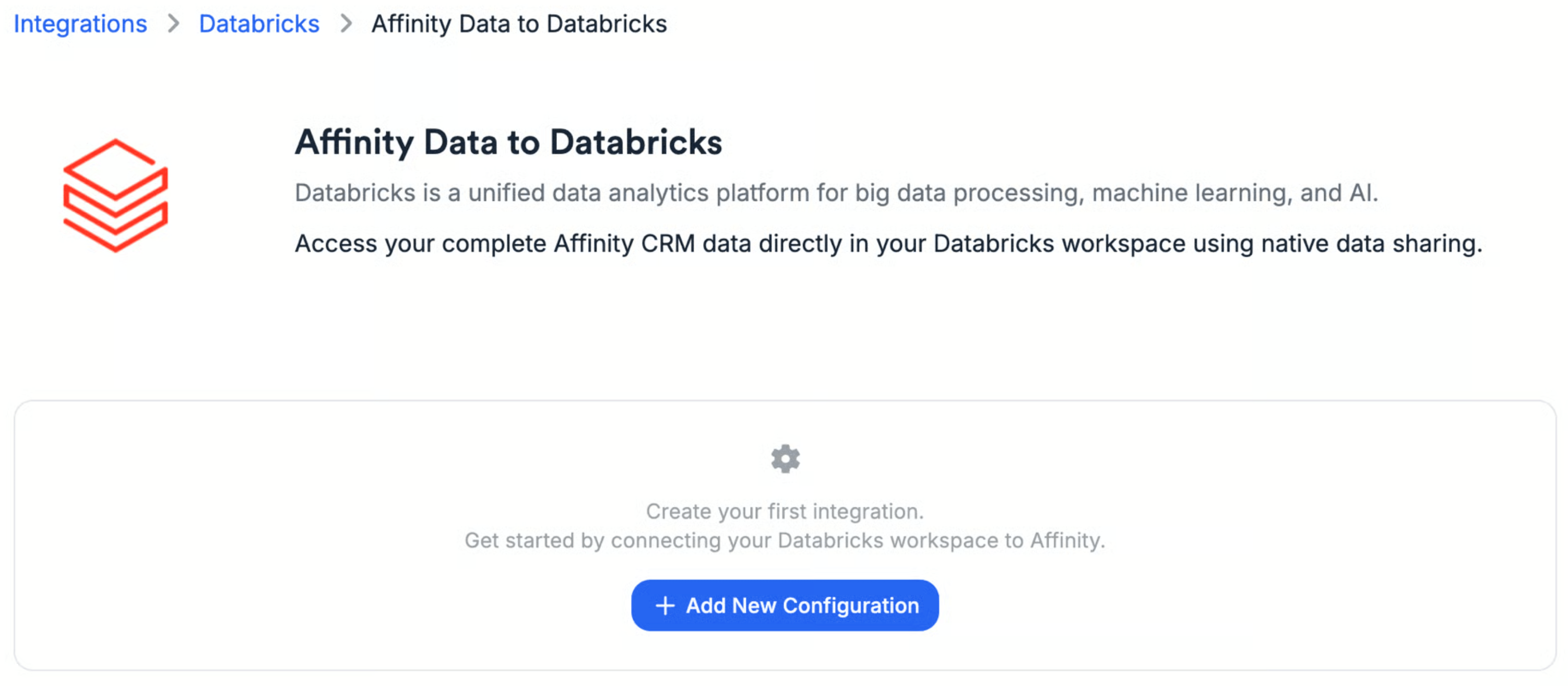
- In Affinity, go to Settings → Integrations → Databricks → “Affinity Data to Databricks.”
- Click “Add New Configuration.”
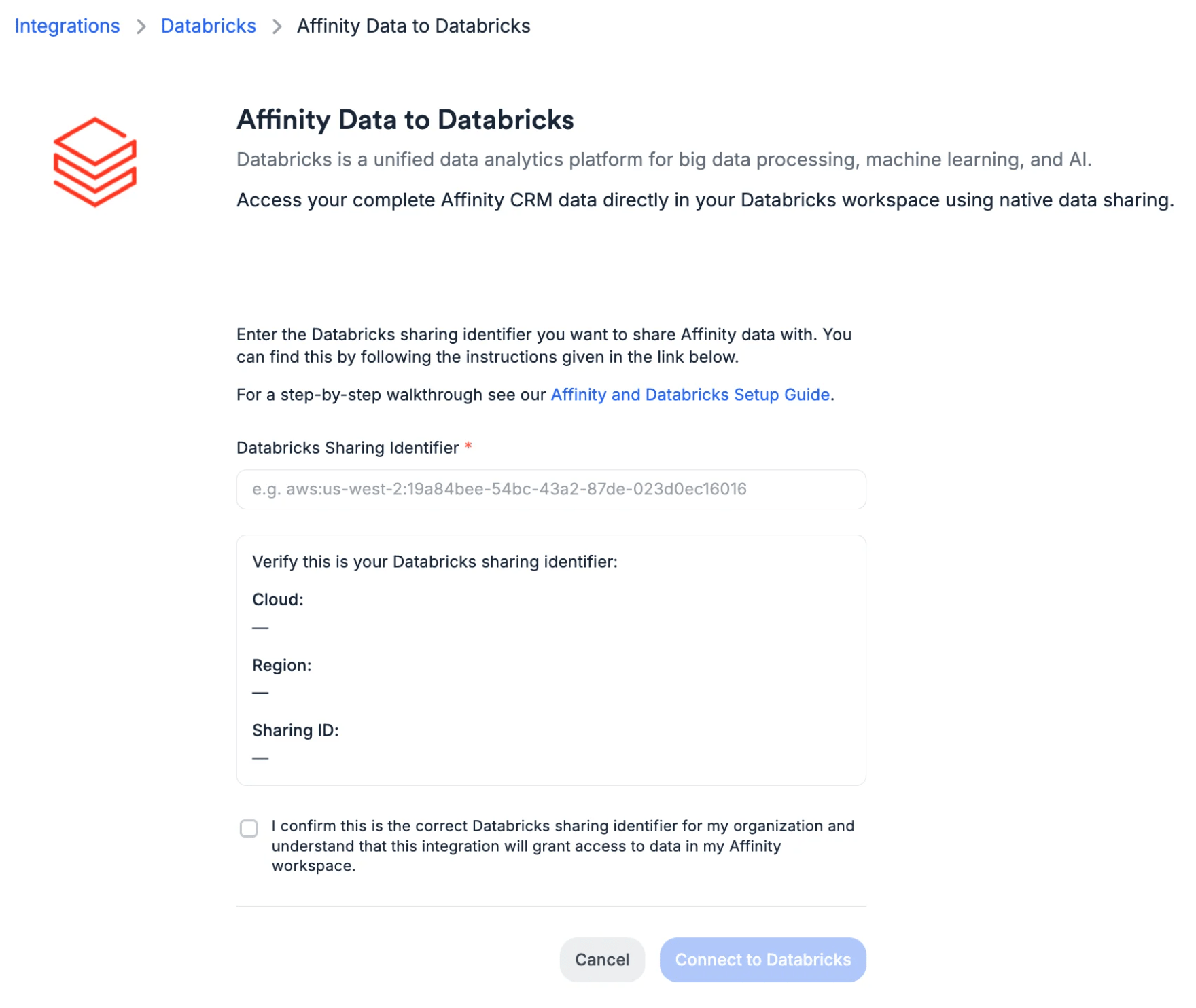
- Paste your identifier into the Databricks Sharing Identifier field.
- Check the confirmation box, then click “Connect to Databricks.”
Step 3: Mount and use your data
Once Affinity has shared the data, mount it in Databricks:- Go to Catalog → gear icon → Delta Sharing.
- Open the “Shared with me” tab and find the Affinity provider and share.
- Click “Mount to catalog,” give the catalog a name, and click “Create.”
What’s included
The share includes your core Affinity data, such as:- Companies, people, and opportunities
- Lists and list entries
- Interactions — emails, meetings, calls, and chat messages (plus meeting transcripts)
- Notes
- Relationship strengths and your custom fields
How often it updates
Data refreshes about every 2 hours — so it’s close to current, but not live.Good to know
- Beta. The Databricks integration is in Beta — expect it to keep improving, and share feedback with your account manager.
- Access is org-wide. The share includes all of your organization’s Affinity data and doesn’t apply Affinity’s in-app permissions — grant access only to people who should see everything, and use your Databricks (Unity Catalog) access controls to limit it further.
- Read-only — the share never changes anything in Affinity.
- Deleted records stay in the share for about 7 days (marked as deleted) before they drop off.
- Plans: Advanced and Enterprise only, and enabled by Affinity.
Troubleshooting
I don’t see Databricks under Settings → Integrations. Data Share may not be enabled for your org, or you may not be an admin. Contact your account manager or support@affinity.co. The share hasn’t appeared in Databricks. It usually arrives within a few minutes; then look under Catalog → gear icon → Delta Sharing → “Shared with me.” Double-check the sharing identifier you entered, and that your workspace is Unity Catalog-enabled. I can’t mount the share. Mounting needs metastore admin, or theCREATE CATALOG and USE PROVIDER privileges — ask your Databricks admin if you don’t have them.
The data looks out of date. The share refreshes about every 2 hours, so very recent changes may not have synced yet.
Still stuck? See the Data Share developer docs, or contact support@affinity.co.